


Many people living with neuroplastic symptoms carry a quiet, persistent question: “If I feel this so strongly in my body, how can it possibly be coming from my brain?”
It’s an understandable doubt. The sensations are real. They’re physical. They interrupt daily life. They can feel frightening, unpredictable, and impossible to explain. And when symptoms don’t show up clearly on scans or blood tests, doubt often grows louder.
But here’s the truth that helps so many of my clients breathe again: Neuroplastic symptoms are real, and they come from a nervous system that has become overprotective — not from structural damage.
Understanding this changes everything.
Why the symptoms feel so physical
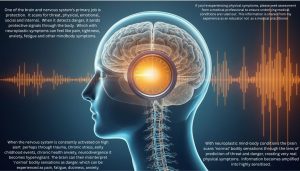
The brain’s primary job is protection. Every moment, it scans for threat — physical, emotional, social, or internal. When it detects danger, it sends protective signals through the body:
- pain
- fatigue
- dizziness
- gut symptoms
- tightness, pressure, burning
- cognitive fog
- anxiety sensations
These are not imagined. They are real physiological outputs created by the nervous system.
When the brain becomes hypervigilant — through trauma, chronic stress, neurodivergence, perfectionism, or long-term health anxiety — it starts to misinterpret normal bodily sensations as danger. The volume knob on sensation gets turned up. The brain begins to:
- amplify small sensations into big ones
- create symptoms pre-emptively (“better safe than sorry”)
- repeat symptoms in familiar contexts
- produce symptoms even when the body is safe
This is central sensitisation. This is neuroplasticity. This is how the brain learns patterns — and how it can unlearn them.
The brain as a prediction machine
One of the most helpful ways to understand neuroplastic symptoms is this:
The brain doesn’t wait for danger. It predicts danger.
And when it predicts danger often enough, it can generate symptoms before anything is wrong.
We see this in everyday life:
- blushing when embarrassed
- butterflies before an exam
- stress headaches
- IBS flares during conflict
- phantom limb pain
- pain that moves or changes with attention
These sensations are created by the brain, but they are felt in the body. Neuroplastic symptoms work the same way — just on a larger scale.
“But my symptoms feel so real…”
Clients often say this with a mix of fear and frustration.
And I always respond with the same truth:
“Your symptoms are real. The cause is functional, not structural — and that means they can change.”
This distinction matters. It protects clients from feeling dismissed. It helps them understand their experience without shame. And it opens the door to healing.
Why doubt shows up — and why it’s normal
Doubt is not resistance. Doubt is protection.
When someone has lived with symptoms for months or years, their brain becomes cautious about changing the story. Doubt is the nervous system saying:
- “Are you sure I’m safe?”
- “What if this is something serious?”
- “What if I’m missing something?”
Every client feels this at first. Doubt is part of the process, not a sign of failure.
How to work with doubt gently
- Validate the physical reality
You need to hear:
- “Your symptoms are not imagined.”
- “Your body is genuinely producing these sensations.”
- “This is physiology, not psychology.”
Validation softens fear.
- Explain the mechanism simply
A friendly way to frame it:
“Your brain is sending danger signals even though your body is safe. The sensations are real — they’re just coming from an overprotective nervous system.”
This helps clients understand without feeling blamed.
- Use your lived experience
Ask questions like:
- “Do your symptoms ever move or change?”
- “Do they worsen with stress?”
- “Do they improve when you’re distracted?”
These patterns are incompatible with structural disease. Clients often recognise themselves immediately.
- Offer yourself micro-experiments
Small, gentle experiments help clients feel the neuroplastic mechanism:
- grounding
- orienting
- slow breathing
- softening around a sensation
- shifting attention
- gentle movement
When symptoms change even slightly, doubt loosens.
- Reframe doubt as part of healing
You can say:
“Your doubt is a sign your brain is recalibrating. We’re not trying to eliminate doubt — we’re helping your nervous system feel safe enough to update its predictions.”
This turns doubt into a companion rather than an obstacle.
The hopeful part
The nervous system is changeable. It learns. It adapts. It rewires.
Through compassion, co-regulation, and gentle retraining, the brain can turn the danger signals down. Clients begin to experience moments of relief, then longer stretches of ease, then a new baseline.
This is the heart of neuroplastic healing: Kindness and safety reshape the nervous system.
A final word
If you’re living with neuroplastic symptoms, your experience is real. Your body is not failing you — it’s trying to protect you. And with the right support, your nervous system can learn to feel safe again.
You are not imagining this. You are not broken. You are not alone.
Your brain is capable of change, and so is your experience of your body.
Disclaimer:
Everything I share comes from my therapeutic and educational experience, not from medical training. If you’re experiencing physical symptoms, please seek assessment from a medical professional to ensure underlying medical conditions are ruled out. My work sits alongside medical care — never instead of it.