


Why the Brain Creates Such Intense Pain and Fatigue
How can the brain create all these symptoms?
Attunement, Polyvagal Theory & the Unresolved Stress Response
Why do neuroplastic symptoms feel so big?
If you live with chronic pain, fatigue, dizziness, gut issues, migraines, or other neuroplastic symptoms, you may have wondered:
“How can symptoms this intense not be biomedical?”
It’s a deeply understandable question.
The answer lies in how the nervous system learns safety, stress, and emotional expression — starting in childhood.
How childhood attunement shapes the stress response
When a child is attuned to — seen, soothed, understood — their nervous system learns:
- emotions are safe
- stress rises and falls
- connection brings regulation
- the body can return to calm
This creates a resolved stress response:
- Stress happens
- Cortisol rises
- Muscles activate
- The child mobilises (crying, reaching, protesting, seeking comfort)
- The caregiver responds
- The stress cycle completes
- The body returns to homeostasis
This teaches the brain:
“Stress has an end. I can move through it.”
When attunement is missing, mobilisation is blocked
If a child’s emotions are ignored, criticised, or too overwhelming for caregivers, the body learns:
- “My feelings are too much.”
- “I must stay quiet or pleasing to stay safe.”
- “It’s not safe to express or complete the stress cycle.”
This creates an unresolved stress response:
- Stress happens
- Cortisol rises
- Muscles activate
- Mobilisation is blocked
- The defensive state stays active
- The body remains on high alert
This is the beginning of chronic dysregulation.
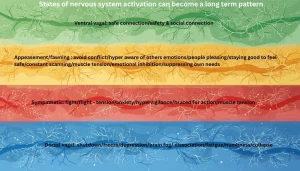
Polyvagal theory explains why the body gets stuck
According to polyvagal theory, the nervous system shifts between:
- Ventral vagal (safe & connected)
- Sympathetic (fight/flight)
- Dorsal vagal (shutdown)
When mobilisation is blocked in childhood, the system gets stuck between:
- sympathetic activation (tension, anxiety, hypervigilance)
and - dorsal collapse (fatigue, numbness, shutdown)
This becomes the body’s long-term pattern.
Appeasement and Fawning - emotional suppression keep the cycle incomplete
Many adults with neuroplastic symptoms learned early on to survive by:
- pleasing others
- avoiding conflict
- staying hyper-aware of others’ emotions
- suppressing their own needs
- staying “good” to stay safe
This is the fawn response — a polyvagal survival strategy.
But fawning requires:
- chronic muscle tension
- emotional inhibition
- constant scanning
- self-silencing
Over time, this becomes the body’s default state.
The stress cycle never completes.
The body never returns to calm.
Why symptoms become so intense
When the stress cycle is unresolved, the body holds the activation inside.
This can lead to:
- chronic pain
- fatigue
- headaches
- gut symptoms
- dizziness
- sleep disruption
- hormonal shifts
- immune activation
These symptoms are real, physical, and produced by the body’s danger system — not imagined, exaggerated, or “all in your head.”
The intensity reflects the intensity of the survival response.
The hopeful part: the stress cycle can be completed now
What the nervous system learned, it can unlearn.
Healing happens through:
- co-regulation
- emotional expression
- self-compassion
- completing the stress cycle
- polyvagal-informed practices
- reducing fear around symptoms
- reconnecting with the body gently
This teaches the brain:
“I am safe now. I don’t need these symptoms to survive.”
And the brain listens.
Reflection
Where do I notice my stress cycle getting stuck?
What helps my body feel safe enough to complete it?
Kindness and safety reshape the nervous system.