How fear keeps symptoms alive — and how safety helps them soften
Many people living with neuroplastic conditions, chronic pain, chronic fatigue, dizziness, or other persistent symptoms notice a familiar pattern: a symptom appears… fear rises… the body tightens… and the symptom gets stronger.
It can feel confusing, frustrating, and never-ending.
But there’s a reason this happens — and understanding it can be the beginning of real change.
This is the fear–symptom cycle, and it’s one of the most powerful (and misunderstood) patterns in the nervous system.
The Cycle: How Symptoms and Fear Feed Each Other
When a symptom shows up, the brain’s first job is to assess danger.
It quietly asks:
“Is this safe… or is this a threat?”
If the brain leans toward “threat,” even slightly, the nervous system shifts into protection mode. That protection can look like:
- worry
- scanning the body
- avoiding movement or activities
- trying to fix or control the sensation
- frustration or fighting with the symptom
These reactions are completely human.
They’re your brain trying to keep you safe.
But here’s the tricky part:
the more the brain protects, the louder the symptoms can become.
Over time, the cycle looks like this:
Symptom → Worry → Avoidance → More sensitivity → More symptoms → More fear
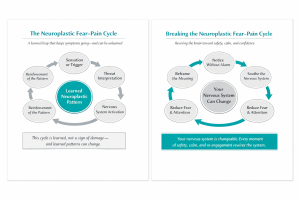
Not because your body is broken — but because your brain has learned a pattern.
The Many Faces of Fear
Fear isn’t always dramatic.
Sometimes it’s subtle, logical, or disguised as “being careful.”
It can show up as:
Anticipation
“What if this happens again?”
Catastrophising
“What if this gets worse?”
Trying to fix
Constantly checking, researching, adjusting.
Hyper-focus
Monitoring every sensation.
Frustration or fighting
“I can’t cope with this.”
“I need this gone.”
These are all forms of fear — and none of them are your fault.
They’re learned protective responses.
Awareness: The First Step Out of the Cycle
The moment you can notice the pattern, something shifts.
You move from being inside the fear
to observing the fear.
Try gently naming what’s happening:
- “This is anticipation.”
- “This is my brain trying to protect me.”
- “This is the fear–symptom cycle.”
Awareness interrupts the automatic loop.
It creates space.
It softens the urgency.
And that space is where change begins.
Creating Safety: The Heart of Rewiring
If fear fuels symptoms,
safety softens them.
Safety tells the brain:
“You’re okay. You can stand down.”
Here are simple ways to create that sense of safety:
- Gentle self-talk
“This is uncomfortable, but not dangerous.”
“I can be with this.”
“My body is doing something protective.”
- Small, safe movements
Slow shoulder rolls.
Stretching fingers.
A short walk.
Movement is one of the strongest signals of safety the brain understands.
- Somatic tracking
Noticing the sensation with curiosity instead of fear.
Letting it be there without bracing.
- Visualisation
Imagining warmth, space, or softness around the sensation.
- Safety through memory
Recalling a moment of calm or connection.
- Safety through people or places
Being with someone grounding, or imagining a place where your body feels at ease.
These small signals — repeated — help the nervous system relearn calm.
A Kinder Way Forward
Your symptoms are real.
Your body is not broken.
Your brain is trying to protect you.
And protection can be retrained.
You are not stuck.
You are not failing.
You are learning, and your nervous system can learn new patterns.
One gentle moment at a time.