At Art of Wellbeing.uk, I specialise in helping people with neuroplastic conditions reconnect with safety, ease, and regulation through gentle, body-based practices. One of the most transformative tools I share with clients is Stanley Rosenberg’s Basic Exercise — a simple, two-minute routine that supports vagus nerve function, nervous system regulation, and the body’s natural capacity to heal.
If you’re living with chronic pain, fatigue, anxiety, functional symptoms, or long-standing stress patterns, this exercise offers a grounded, accessible way to help your system shift out of survival mode and into a state of calm connection. It’s a cornerstone of somatic healing and a beautiful example of how small practices can create meaningful change.
Who Is Stanley Rosenberg? Understanding His Approach to Nervous System Healing
Stanley Rosenberg is a bodyworker and author whose work explores the relationship between the cranial nerves, the vagus nerve, and emotional wellbeing. His approach is rooted in polyvagal theory — the understanding that our nervous system constantly scans for cues of safety or danger.
His solution was simple and accessible: The Basic Exercise, a gentle somatic practice that helps unwind tension at the top of the spine and stimulate the vagus nerve.
Why the Vagus Nerve Matters for Emotional and Physical Wellbeing
The vagus nerve is the main pathway of the parasympathetic nervous system, responsible for rest, digestion, connection, and calm. When vagal tone is low, people may experience:
- anxiety or hypervigilance
- shutdown or freeze responses
- chronic pain
- digestive issues
- emotional overwhelm
- difficulty relaxing or sleeping
For those with neuroplastic conditions, these patterns can become deeply wired into the nervous system. The Basic Exercise offers a gentle, trauma-informed way to interrupt these patterns and invite the body back into safety.
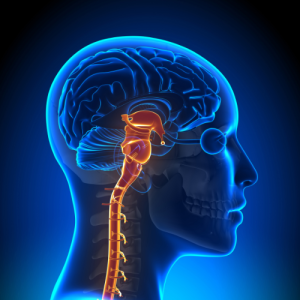
Image of brain stem and nerve
How the Basic Exercise Supports Vagus Nerve Function
Practising the Basic Exercise supports:
- activation of the rest-and-digest system
- improved mobility in the upper neck
- increased blood flow to the brainstem
- healthier cranial nerve function
- reduced protective tension patterns
- improved vagus-nerve signalling
In simple terms:
It helps your system shift from “I’m bracing” to “I can settle now.”
Many people experience sighs, yawns, swallows, or a softening of the eyes — signs that the nervous system is releasing tension and returning to regulation.
Step-by-Step Guide: How to Practise the Basic Exercise Safely
You can practise this sitting or lying down. If you’re sensitive or overwhelmed, lying down is often the gentlest place to begin.
- Notice your neck.
Turn your head slowly side to side. No judgement — just information. - Interlace your fingers behind your head.
Let your head rest into your hands. - Without moving your head, move your eyes to the right.
Hold for 30–60 seconds.
Wait for a natural release (a sigh, swallow, yawn, or softening). - Return your eyes to centre. Rest.
- Repeat with your eyes to the left.
- Re-check your neck mobility.
Most people notice more ease or spaciousness.
How the Basic Exercise Helps People with Neuroplastic Conditions
Neuroplastic conditions are not “all in the mind.” They are patterns wired into the nervous system through repeated stress, fear, pain, or overwhelm.
The hopeful truth is that the nervous system is changeable — it can learn safety again.
The Basic Exercise supports this by:
- giving the body a direct experience of settling
- interrupting habitual tension patterns
- strengthening vagal tone
- helping the brain reinterpret sensations as safe
- creating micro-moments of regulation that accumulate over time
For many clients at Art of Wellbeing.UK, this becomes a foundational tool — a way to remind the body that safety is possible.
The Science of Safety: How the Nervous System Learns New Patterns
One of the most encouraging truths about the nervous system is this:
if the body can learn patterns of protection, it can also learn patterns of safety.
The responses we often label as “symptoms” — tension, pain, shutdown, anxiety, over-alertness — are not failures. They are learned survival strategies. They were the body’s best attempt to keep you safe.
And because these patterns were learned, they can be unlearned.
They can be softened, rewired, and replaced with new experiences of ease and connection.
Every time you practise something like the Basic Exercise, you’re offering your nervous system a tiny moment of safety. These moments accumulate. They become new pathways. They become new possibilities.
Your Path to Regulation
At Art of Wellbeing UK, my work centres on helping people with neuroplastic conditions reconnect with safety, resilience, and self-trust through gentle, somatic practices. The Basic Exercise is one of the simplest yet most powerful tools for supporting vagus nerve health, nervous system regulation, and long-term wellbeing.
Your nervous system is not stuck.
It is adaptable, responsive, and always listening.
With the right support, it can learn to feel safe again — and that changes everything.